Hi! My name is Gianna, and my blog is here as a living journal of my experiences in Panamá. I hope it can also serve as a resource for anyone interested in Peace Corps life. ¡Gracias por leer pues!
They say that scent is the most nostalgic sense. Smelling something specific from your past can take you right back to that moment in time. I think about this when I get a whiff of my wet hair in the morning. I started buying the same shampoo that I used to use in Panamá. When I close my eyes and inhale its scent, I am bathing in my outdoor shower in the heat of summer again. I get hit with a wave of memories when my Honduran roommate cooks plátanos in our shared kitchen. It reminds me of my weak attempts at frying patacones on my little gas stove in my little concrete kitchen. Sometimes, it feels like that year was all a dream. Other times, when the sounds of the city wake me in the middle of the night, I fall into a panic because I still don’t recognize my new bed.
Tonight I am stuck staring at a screen for the billionth time since the pandemic began, trying to put into words how different my life is right now than it was one year ago. March 19, 2021 will mark one year since I was evacuated from Panamá and Peace Corps to the United States. Due to rising concerns of the coronavirus spreading in country, Peace Corps staff told us we had no time to say goodbye. Grab what you can and get out of site, they said. So, I never got to say goodbye to my community, mi gente. But I can’t blame Peace Corps staff for this. I knew the virus wasn’t so bad that it would have spread to the mountains of Coclé already. I knew I had time to visit people one last time. Still, directly after I dropped off my keys to my neighbor, I. Just. Left. But I didn’t speed away from my community because I was so eager to go back to the US. It was the opposite: I couldn’t face the sad, scary truth that I was leaving Panamá. I couldn’t make myself run around yelling permiso! from house to house to tell all my favorite people that I had to go but that I loved them. I convinced myself that my departure was only a break. I’d be home soon. No need to be dramatic.
A year has passed, and I sorely regret not saying goodbye to my Panamanian friends and neighbors, to every single person who looked after me as if I truly belonged in their community. Because now I know I am not going back. It’s not that I can’t go back. Peace Corps HQ keeps calling and emailing me to perform the necessary steps toward reintegration into service, so the option is there. And it’s definitely not because I don’t want to go back. I miss Panamá more than I’ve ever missed anything in my life. I stay in touch with mi gente on WhatsApp but its not the same as paseando every day. Maybe it’s selfish, but I equate my evacuation with a death or a breakup. I’m still trying to process the pain of never getting that second year of Peace Corps. Peace Corps shaped my identity. Without it, I have been desperately grasping for something as meaningful. It feels like something I can never truly get back, that part of my life. But that is also exactly why I won’t return to service.
The year 2020 changed me as it changed everyone. Peace Corps made me feel like I was special. Evacuation made me realize that I am not. I still believe I have a lot to give, but I can’t imagine that being a Peace Corps Volunteer even in a post-COVID world is exactly what my community or Panamá needs. It’s also not what I need right now, even if I really want it. I need something more sustainable. I need to lean into my new job, volunteering gigs, reaching out to friends for video calls, piles and piles of creative projects, and reading all the books that I left on my shelf back in 2019. I need to take another big leap of faith at a new dream. And for the past several months, I have been steadily working toward a new dream. It’s exciting and something that can offer me both stability and advancement. Those are things that, right now, Peace Corps can’t offer me. Maybe I will apply again some day, but right now the pain is still too raw. My community doesn’t need me, and they never did. It’s not really a hard pill to swallow. It’s just hard to find the strength and the maturity to move on.
Someday, I will return to Panamá to visit my community. I wonder how my presence will be perceived then. Will they remember me as that weird gringa who chomped on carrots as she walked down the hill? Will I be welcomed back as the ticher who incorporated new activities into the English and counseling curriculums? Who made it a point to get to know every single person at the school whether or not they were counterparts in the classroom? Will they remember me simply as the friendly extranjera who went around house to house, brazos llenos de pastel de guineo? I do not know if they will even really remember me when I have the chance to return. But, whenever I do visit, I promise that I will fill my nose and lungs with the sweet mountain air like it’s the last time. I will give strong hugs and speak sin pena.
In February of 2020, I celebrated my one-year anniversary with Peace Corps Panamá. I had just completed a series of school orientations, planned out an entire semester’s worth of projects with my counterparts, and returned from a major Carnivales cross-country festival roadtrip with other PCVs. It was the start of a great second year.
However, by the end of March 2020, I was on a plane being evacuated back to the United States due to COVID-19. I was instantly seperated from my Peace Corps friends, my Panamá home, and the future for which I had planned. This was the experience of 7,000+ Evacuated PCVs all over the world.
I returned to the US feeling very defeated and depressed. I had only served one of my two years with the Peace Corps, and I wasn’t ready to say goodbye…
¡Hola tod@s! I’m back with my friend Emma Jones who worked in Columbia as a Fulbright scholar while I lived in Panama as a PCV. Read about Emma’s travels, adventures, and book reviews on her blog “Emma Shut Up” at https://emmashutup.wordpress.com/!
My and Emma’s plan to meet up during Semana Santa was dashed by COVID-19, sadly. However, we decided to keep in touch and work on an essay together comparing her Fulbright experience with my time in the Peace Corps. We both lived in Latin-American countries (neighboring countries at that!) and worked in English-teaching environments, but we both had unique experiences on the job. If you’re thinking about applying to Fulbright or Peace Corps in the future or just are curious about how they compare, here are a series of questions that Emma and I have answered to help guide you!
Disclaimer: the experiences and opinions expressed in this essay reflect Emma’s and my personal experiences and do not speak for everyone who has ever been a part of the Fulbright or Peace Corps programs.
What, in a few words, is the purpose of Fulbright/Peace Corps?
Emma: The Fulbright Program’s mission is to “fund the promotion of international good will through the exchange of students in the fields of education, culture, and science.” Fulbrighters can be sent from the U.S. to another country, or vice versa, to study, conduct research, or teach English (or their native language in the U.S.). These scholarships fall under either the Student Program, for current students or young professionals, or the Scholar Program, for Ph.D. holders or established professionals.
Gianna: The Peace Corps’ mission is to “promote world peace and friendship” through three goals: (1) to help the peoples of interested countries in meeting their need for trained men and women; (2) to help promote a better understanding of Americans on the part of the peoples served; and (3) to help promote a better understanding of other peoples on the part of Americans.
Emma leading conversational activities with university studentsGianna leading summer school classes to seventh graders
How much of a choice do you have in where you are sent to work?
Emma: With Fulbright, you apply to work or study in a certain country and only that country, no second choices or backups. (A friend of a friend was offered a grant in Brazil when she applied for Argentina and was rarely seen without a Portuguese textbook for the next several months, but I’ve only heard of that happening once.) If you do receive the Fulbright, you may be asked whether you would prefer a large or small city, large or small university, etc. Since you get to pick where you go, you need to have a compelling reason why you chose to apply to the country you did. “I like Italian food” isn’t going to cut it. In my application to Colombia, I talked a lot about my love for Gabriel Garcia Marquez, Colombia’s most famous author, and my interest in becoming a translator from Spanish.
Gianna: Up until about four years ago, Peace Corps applicants had little influence over where they would be stationed and what kind of position they would hold. Their future was left up to the Peace Corps to decide where they were “needed most.” The “send me anywhere” route is still available for applicants willing to serve anywhere in the world. However, now applicants have the option of applying to specific programs in the countries of their choice while also choosing three parts of the world (ex: Southeast Asia) as alternatives. This is the route I chose when I applied to the English Co-Teacher & Life Skills Facilitator position in the Education sector of Peace Corps Panama. I made this decision with my skills and experiences in mind as well as where I could see myself living for two years. With that said, I know several Returned Peace Corps Volunteers who chose “send me anywhere” had positive services in the countries and programs where they were placed.
What is the application process like?
Emma: Applying for the Fulbright requires you to do a lot of advance planning. To be an ETA, you need three recommendation letters, a personal statement, a statement of grant purpose (where you describe the kinds of activities you want to complete during the grant), and a campus interview with several different faculty who will ask you questions about why you want to work or study in the country you chose. You also may need a Foreign Language Evaluation, which describes your ability to speak the language of your host country. For a research or study grant, you need all this plus a letter of affiliation from the university you want to work with in the host country. Usually you will apply through an institution of higher learning you attend or attended in the past, and many campuses have earlier deadlines than the official Fulbright deadline. If you make it to semifinalist level, which means the US government is passing your application along to the host country’s government, you may have to complete some additional requirements. For me, that was a short interview in English and Spanish and a personality test. The materials necessary also depend on whether you are applying for an ETA grant, a research grant, or a study grant. If you’re a finalist, which means you are selected for a grant, you also have to undergo medical clearance. Some countries have an Alternate designation, which means you may be awarded a grant if someone drops out or there are more available spots than planned. The process takes as long as it takes – I changed the country I wanted a month before the application was due and started all over, which some would call application suicide. But I knew more than one Fulbright in Colombia who started the application only a few weeks before the deadline – and guess what? We all ended up in the same place. (I’m not endorsing what they did, though. Plan ahead.)
Gianna: The Peace Corps application process takes about a year. Because it is so lengthy and detailed, I recommend getting in contact with a Peace Corps recruiter to help guide you through the process; my recruiter helped me so much, and I’m still connected with her! The first step requires filling out the application form on the Peace Corps website which includes writing a mission statement, submitting a comprehensive resume, and three references. Once you submit this form, you will be invited for a Skype interview with someone from the hiring office. Sometime after the interview, you will receive a message inviting you to serve with the Peace Corps under a specific position and country program. You have three days to accept or decline the invitation. If your program requires a foreign language placement test, you will have a follow-up interview to determine your speaking level. The second half of the application process requires obtaining medical and legal clearance. In a nutshell, this means submitting proof that you are able and qualified to serve including but not limited to birth certificate, passport, dental scans, and blood tests. Once you are legally and medically cleared, you are officially invited to begin Peace Corps training.
How long is the commitment?
Emma: Most of the time, Fulbright will send you to teach or study in a country for eight to twelve months. For an ETA grant, it will likely be slightly less than twelve months, or the length of one school year – my tenure in Colombia would have been ten months, had it not been for this coronavirus business. A master’s grant might be a bit longer, depending on the program.
Gianna: Peace Corps Volunteers serve a total of 27 months in their country program. Three of these months are training which means the standard Peace Corps service is two years. Peace Corps Response positions are shorter (typically 8 to 12 months) and are attached to specialized projects. However, these opportunities are only open to Returned Peace Corps or professionals who have worked in related positions.
Emma sightseeing in Bogota Gianna’s host family walking after a rainy day
How were you trained?
Emma: I . . . wasn’t! This is only a slight exaggeration. Specific training is generally not required for ETAs, although many countries specify they want ETAs who have had some kind of teaching or tutoring experience. I was a tutor for three years in college and helped in English classes for a few months while studying abroad in Chile but had never really taught English as a foreign language. Starting next year, ETAs in Colombia will receive ESL training online the summer before they arrive, which I think is an excellent idea. If you end up in a country that doesn’t offer you training and you have questions about the best way to go about your job, do not ever be afraid to ask!
Gianna: All Peace Corps cohorts go through three months of pre-service training before they are officially sworn into the program and placed in their communities. During these three months, Peace Corps trainees travel back and forth between their host training communities and the country program’s office to receive a variety of training sessions related to their work. These sessions include administrative procedures, language and culture reinforcement, safety and security protocol, and medical information. In addition to these general sessions, trainees receive technical training specific to their sector. For example, I served in the Education sector of Peace Corps Panama which required me to complete formal training on co-planning and co-teaching lesson plans, the Panamanian education system, English teaching methodology, and critical skills development for children, youth, and adults. However, training for volunteers in the Agriculture, Health, and Environment sectors requires the development of different skills and is paired with different agencies within the same country.
What kind of work were you doing?
Emma: As an ETA in Colombia, I was placed at a university in Bogota and helping in English classes. I did not teach alone, but I usually led culture-centered activities in class and incorporated grammatical concepts. I also administered the speaking portion of English exams, which were a requirement to graduate from my university. Fulbright Colombia also requires you to have a social project for about 10 hours a week (as opposed to 20-30 for teaching). My project was writing for The City Paper of Bogota, an English-language newspaper in Bogota.
Gianna: As an English Co-Teacher & Life Skills Facilitator, I was placed in a Panamanian community and school to promote English learning, dynamic teaching methodologies, and critical skills (leadership, women’s empowerment, college and career prep, safe sex, etc.) development for youth and adults. I co-taught or co-facilitated classes and seminars with Panamanian counterparts rather than leading alone.
What was the hardest part?
Emma: I would say the most difficult part for me was navigating Colombian cultural norms in my workplace, especially regarding communication. Colombian work culture involves a lot of small talk; it’s considered very rude to walk into a room without greeting everyone and asking after them and their families. At my university, there were also a lot of work parties for birthdays and other occasions. I’m introverted by nature, and as a result, the constant pleasantries and work parties/gatherings exhausted me, whereas my coworkers thought me cold and impolite for not greeting them all when I walked in. After speaking with my boss, I realized much of this conflict was due to culture clashes, and I tried to interact more with my coworkers, which helped a lot. I also struggled with the Colombian “just go ask” mentality in regards to questions and proposals; I often had to speak to six different people to accomplish a task that could have been solved in the U.S. with an email. It took a while to get used to, but I’m glad to have had the experience; it helped me explain concepts of U.S. culture to my students more clearly because I could compare them to Colombian practices.
Gianna: The hardest part of my Peace Corps service was being the judge of my own work. Although I worked under the guidance of two program specialists and one program manager, my bosses were hours away in Panama City and were only available by phone call. I submitted reports about my projects every six months, and even on those I received little feedback. The Panamanian teachers and school staff I worked with did not formally evaluate my work, nor did the recipients of my classes and seminars. My fellow PCVs were there for advice and brainstorming, but they were all also working on their own projects without supervision. So, the only person who could keep my work accountable was me. I struggled with comparing the quality of my projects and my level of productivity to other PCVs’ and feeling confident that my work was actually helping my community. Though there were other hard parts of service like loneliness and cultural barriers, judging my own work was consistently the hardest.
What was your favorite part?
Emma: My favorite part of my grant was getting to live in Bogota, a city that constantly gets a bad rap from those who visit it because they compare it unfavorably to the cleaner, warmer, and overall more “tranquila” Medellin. I adore Medellin, but Bogota is second to none in terms of things to do: there are outdoor jazz concerts, nature reserves not far outside the city, gorgeous street art near downtown, museums, lots of small and inexpensive theaters. I also loved the food scene there; eating out is relatively cheap, and there are a lot of excellent small, family-owned restaurants in the neighborhood where I lived. I also joined a fantastic church and met wonderful friends there.
Gianna: My favorite part of Peace Corps service was living in Panama. I know it probably sounds like an easy answer, but I truly loved the beauty of Panama. Before I applied to Peace Corps, I researched Panamanian geography, history, and culture. I was mesmerized by the colors and energy that characterized Panama’s beaches, mountains, jungles, festivals, music, and artisan crafts. Living in Panama gave me the opportunity to experience all of these things as a member of the community, rather than a tourist. Of course there were parts of Panama that I didn’t love. But overall, I was so honored to live there for my Peace Corps service. My advice to anyone applying to the Peace Corps, Fulbright, or any program abroad is to think about which parts of the world excite you and where you can see yourself thriving.
Emma enjoying a family-owned cafe in Bogota
Gianna at home with her host family
How were your expectations of your work different from the reality of your work?
Emma: Since I had little experience in teaching English as a foreign language and mentioned in my statement of grant purpose that I would enjoy doing creative writing and literature-related lessons with my students, I assumed I would be placed with students who had a higher, or at least intermediate, English level. This was not the case at all. Most of my students had a beginning level of English, and a few were intermediate. The few we had that might be considered “advanced” often did not take English classes because they cost extra, preferring instead to go right into taking the qualifying exam. As a result, I had to incorporate many more teaching-style methodologies than I anticipated, as opposed to just activity leading. I also rarely saw the same students more than twice a month, as my university wanted me and my fellow ETA to visit as many English classes as possible. I wanted to get to know my students better and had begun to host English clubs outside of class, such as a comics reading/writing club in English. Unfortunately, the coronavirus nipped that in the bud.
Gianna: The Peace Corps has a reputation of placing volunteers in remote, poverty-stricken villages to do work that will “save lives.” Although this is the case for some volunteers, including volunteers in Panama, it was not my experience. The community I lived in is part of a district that is populated by 6,000+ individuals. My home had electricity and running water. Some people in the community have cars and televisions. The provincial capital (location of cafes and grocery stores) was only an hour away for me by bus. Although my work in education and youth development was meaningful, it did not even come close to saving anyone’s life. I really did not expect these “Posh Corps” luxuries. On the other hand, I was not prepared for the anticipated “tough” aspects of Peace Corps life either. I adapted to showering in a closet-sized latrine, being without power and cell signal several times during the week due to harsh weather, and working in a school system that lacked my American standards of productivity and organization. My Peace Corps experience did match some of the expectations I made based on others’ experiences, but in most ways I had to adapt to circumstances that were completely unique to my service.
What is the probability I will be granted a position?
Emma: Depends on the country and year. For English Teaching Assistantships to Colombia in the year 2019, the acceptance rate was a little over 20 percent. Some countries offer a lot more grants than others, and that’s also a factor. For example, the acceptance rate for Italy is usually around 10 percent, but they only offer 10-15 ETA grants per year. Colombia offers about 80. Remember, you need to have a compelling reason to apply to the country you choose, so apply to the country you really want to be in, not the one that has the highest acceptance rate.
Gianna: According to its website, the Peace Corps received more than 17,000 applications for fewer than 4,000 positions last year. I was one of 20 invited out of 200 applicants for the TELLS (Teaching English, Leadership, and Life Skills) position in Panama. I’ve heard that connecting with a recruiter and/or choosing the “send me anywhere” option increases the chances that you will be invited.
Do you plan to apply for Fulbright/Peace Corps again? Can you apply again?
Emma: Once you receive a specific Fulbright grant, you can never apply for that grant again. Usually, I wouldn’t be able to apply for an ETA grant again, but Fulbright made an exception for my cohort because of the coronavirus. You can, however, receive an ETA grant and then a research grant three or more years later. I’ve met someone who has done this, and for the same country both times, so it is possible! I’ve been playing with the idea of applying for a research grant.
Gianna: Under normal circumstances, Peace Corps volunteers have multiple options for staying involved after their two-year service is complete: re-apply to Peace Corps in a different country, extend their service in the same country as a program coordinator, or apply to a Peace Corps Response position in the same or a different country. Peace Corps Headquarters is currently working on a plan to reinstate or re-enroll volunteers who were evacuated due to the pandemic. I would love to return to complete my last year of service in my community. However, the Peace Corps’ plan may not overlap with my wishes, so I am looking into other opportunities.
Emma teaching about Halloween while dressed as “Death” from the Sandman series
That’s all that I can think about right now. The small pile of coke cans sitting in the corner of my Panama home kitchen. I was planning on saving up more and giving them to my host sister, a senior in high school, so she could contribute to the school’s annual aluminum can fundraiser. Last year, she brought in the most cans of her class and was crowned reina de las latas of the 11th grade during the parade that followed the fundraiser. This year, I wanted to help her win again.
But my time in Panama is trickling away, like the last bit of sand in an hourglass. Along with all other Peace Corps posts across the world, Panama is releasing volunteers to evacuate back to the United States in response to the COVID-19 crisis. In a few hours, I’ll be leaving my community for Panama City to fly home to comply with the evacuation process.
The first mention of evacuation crashed into me like a wave of devastation and regret. I couldn’t imagine not completing my second, and what would be most productive, year of Peace Corps service. After more talk of evacuation and more time to ruminate on the reality of leaving Panama, it has remained just as devastating.
I try to think of the positives of leaving Panama: a treasured year of memories in a country I now consider home, returning to my friends and family who I very much miss, and a better chance of safety and security under the developing circumstances of the Coronavirus pandemic.
But really, this sucks.
It sucks, and I can’t feel in my heart I’ll ever truly recover from the loss of not completing my Peace Corps service if I’m not able to return this year. I’ll miss my community and the opportunity to finalize all the new projects I had been starting up with my counterparts. I’ll miss the friends and families who welcomed into their hearts and homes. I’ll miss my Panama house, which has been the first place I’ve called “home” outside of my family’s house in Hanover. And I can’t even begin to describe how much I’ll miss my fellow volunteers; they have become some of my best friends. Needless to say, I’m not at all ready to say goodbye to the people who helped me make it through this year.
Through the ups and downs of emotion, productivity, and focus, I have remained a dedicated, enthusiastic Peace Corps volunteer. All I’ve ever wanted was to continue my service. Now that my time is cut short, I feel unfulfilled and regretful of not taking more time in my first year to do more.
I’m hurting, and I’m not even making the most of this hurt. My heart is breaking. All I can do is remind myself of the good memories and the hope that I’ll return soon.
To my Peace Corps family, I love you. Thank you for reading. Thank you for loving me. Thank you for growing and sharing with me. We will meet again ❤️
Yoo hoo! Big summer blog-out 💁🏼♀️ It’s been a while since my last update. And that is because I’ve been busy, busy, busy. The months of January and February are summer vacation (yes, summer – the dry season llegué) for Panamanian schools. But that doesn’t mean this volunteer has had any rest since the holidays!
One thing I got the chance to do over break from school was make a video about my first year in site. I hope you enjoy watching it as much as I enjoyed making it ☺️
Now, without further delay, here are some of the events from this summer that made it so memorable:
Future pioneers of sustainable development
With the teens at the National Institute of Agriculture
My first job since returning from vacation was to help facilitate a series of leadership seminars in Veraguas. The seminars were prepared under the direction of PCV Matt who lives on the campus of the National Institute of Agriculture. The recipients of these seminars were students who came from all over Panama to study agriculture at this institution. Along with other TELLs volunteers, I lead topics about sustainability, SMART goals, and the personal circles of concern and influence each person has to impact the changes they want to see in the world. At times, I felt my Spanish level was too low to express these deep topics. However, it was rewarding to lead questions for this group of teens and listen to what they had to say about the future of their world.
Minor surgery in Panama City
Post-surgery selfie 🤳
Earlier last year, I noticed some lumps in my right arm. I didn’t think anything of it until my family visited in December and encouraged me to see the Peace Corps doctor. The PCMO informed me I had some harmless cysts and needed to get minor surgery in a private hospital in the city. Navigating medical paperwork and appointments in Spanish and in a big, intimidating city was not the way I imagined ringing in the new year. However, I learned so much about the Panama city public transportation system as well as how to manage future medical appointments in the city (but, knock on wood, there will be none). I even got some yummy Korean and Indian food with my friend from Bocas del Toro who also was in the city on medical. That kind of treat is impossible to find in Coclé! But, overall, being in the city made me appreciate my community even more. There’s no place like home en el campo.
Seriously, who would want to leave this place?
Universidad tecnológica English classes
This day, we talked about sharing preferences and writing short narratives.
The past several weeks, Chanel and I have helped out with English courses at the Tech College in Penonomé. Specifically, we bring English conversation topics to the classroom so the students can practice speaking in groups. These classes are comprised of students with different ages and levels, which has tested our lesson-planning and leading abilities. We always need to have extra activities in our arsenal in case the lesson we’d planned is too simple or too complicated for the group. Conversation activities are always rewarding for me because I love hearing students use new vocabulary, argue their opinions, and ask complicated questions.
The kids classes were fun, too!
Medical gira
Dental care was offered at the medical gira in January
A traveling medical team of professionals and students provided free eye, ear, and dental treatment over a week in January. Although I only attended for a few hours one day of the medical tour, I got to put my translating skills to the test. As patients from all over the area (some even from my site!) arrived for care, I checked them in by translating a form asking for their basic information, medical history, and primary health complaints. I also spent a while supporting the ocular experts by administering basic vision exams (you know, the one with the big E?). Although I didn’t spend significant time at the medical gira, it felt rewarding to use my Spanish in a way that directly helped others.
Feria de naranja 🍊
Fair sightseeing with friends!
Every year, the community of Churuquita Grande hosts la feria de la naranja in which all the communities in the surrounding mountains sell their produce, especially piles and piles of the sweetest oranges you can imagine. My community was one of many to set up a cabaña full of fresh fruits and vegetables to market to the hundreds of patrons who visited the fair. For four days, the booths stayed active as well as the center stage for traditional dance performances. I was reminded of the Jefferson County fair, smelling the fried food stands and walking through the dusty fields that lay some – ahem- vintage mechanical rides. The rural community felt during the fair was another indication of the universality of campo culture.
Panamá: where agua de coco is fair food 🥥
Summer school programs in site
Playing and learning with 1st grade ☺️
During the first two weeks of February, I had the opportunity to support the gabinete (counseling department) with two summer programs: dynamic learning sessions with the incoming 1st graders and middle school orientation with the incoming 7th graders. Over my first year in my community, the gabinete has been my favorite entity to work with in the school. Consisting of the school psychologist and school social worker, the gabinete provides counseling for students, teachers, and parents. It is rare that a school in an area as rural and distant from the city has a gabinete; most schools with counseling departments are urban and well-resourced. However, because our school is located in the most active part of the district and enrolls students from so many different neighboring communities, it qualifies for social work and psychological services. When the two women of the gabinete asked me to work during their summer programs, I was more than happy to help.
Roslyn (left) the school psychologist and Ana (right) the school social workerMaking snacks for the 7th graders during the movie party! We watched Harry Potter y la piedra filosofíal
During these two weeks, I helped Roslyn provide activities and games that reviewed basic concepts for the 1st graders such as colors, numbers, dexterity, and memory. These activities were designed to evaluate the development of each student as the enter primary school. The majority of the time, however, I helped Ana with her middle school orientation program as well as taught English classes to the new 7th graders. Over the course of these programs, I learned so much about my teaching abilities as well as how to work more efficiently with my school counterparts. The last day left me exhausted but confident about the start of the new school year.
7th grade orientation and English classes 🤩
Carnavales
Las Tablas is famous for hosting the biggest Carnaval celebrations in the country
After two months full of hard work, it was time to enjoy Carnavales. The Carnavales are celebrated for four days ending the night before Ash Wednesday. The festivities include the coronation of queens from Calle Arriba and Calle Abajo, culeco trucks spraying water at all passersby in the streets, bands and troupes that follow the queens on their elegant floats, and dancing for days. Just like every country that celebrates Carnavales, each city in Panama has its own special traditions and festivities. However, the city of Las Tablas in the province of Los Santos is famous for hosting the biggest Carnaval celebrations in the country. I’m grateful to have been able to travel with a group of my friends to enjoy all of what Las Tablas had to offer this year. We got soaked by culecos all morning and stayed out dancing all night. After recovering from Carnavales, I realized how much I appreciate the lengths Panamanians will go to throw an epic party. Culturally, festivals and celebrations hold significant importance in this country as well as all of Latin America. It is just one more reason to be happy to have spent a whole year living abroad.
¡Viva Panamá!
¡Viva Carnaval!
I did more these past couple months than I can share in this post, including a few fun summer camps lead by other PCVs, but there you have it; a summer full of work and play. The new school year begins this Monday. I am ready to dive into new projects and learning opportunities. May the energy that carried me through my first year of Peace Corps service follow me into my second and last ✌️
Shout out to the Peace Corps homies who made this summer special… …and to the kiddos who remind me why I am here… ..and to memories I’ll always treasure ❤️
Hi folks! I skipped on writing a blog post for December, but I had a great month celebrating the holidays with my school and community.
Yay for celebrating the end of the school year with teachers! 😎
I also spent a nice weekend away in Cerro Punta with other volunteers for the annual Holiday Party!
Yay for seeing 150+ volunteers at Holiday Party!
And, of course, I spent Christmas with my family here! Spending time with my mom, dad, and sister in my community and relaxing with them on the beach was the best way to close off my first year in Panama.
At the big waterfall near my house!Feliz navidad 🎄 Saying ✌️ out to the beach!
Adventures in my site ❤️
Now it’s January 2020, the start of a new year and a new decade. Last year around this time, I posted my first entry on Piece of Panamá titled “Why Peace Corps.” In this post, I look back at a year of blogging and the biggest changes I’ve faced since being away from home.
Challenges
Being away from my family and friends has obviously been hard. I think this is universal for all PCVs. For 23 years, I lived at home with my family of four and we did everything together. Learning to be on my own and not have my family’s immediate love has hurt, but also helped me grow.
Like my family, I always made time for the friends I’d known throughout childhood, too. They have always been family to me as well. Leaving for Peace Corps meant skipping on of my best friend’s wedding, missing out on another best friend’s daughter growing up, and ending an almost 3-year relationship with someone I’d considered a best friend for a decade. These losses still pain me even though I know these people love me and are parts of my life forever.
An additional loss that hit right when I moved to my community was of my dog Woody, my pet of almost 12 years. It hurts still knowing that I couldn’t be there to say goodbye to him and won’t see him when I visit home.
I knew part of why I wanted to leave for Panama was to become more independent away from the home I’ve always known. It’s not been easy, but I am learning about my abilities and goals the more time I spend on my own.
Rewards
It’s hard to see it fully now, but I think in years to come, I will look back at my time in Panama as some of the best years of my life. Why? Well, what I can attest now is that I love being a part of a community. My site is rural, but active, which reminds me of my hometown. I love being able to work with a lot of different Panamanian professionals while also being friends with so many families in this welcoming place.
Before I applied, I knew from the start that I wanted to serve my time in the Peace Corps in a Latin-American/Carribean country. So, I’m lucky that I was accepted into Panama’s program. Learning Spanish and being accepted into a warm and creative culture has all been such a blessing to me as a volunteer. Even on my hard days, I always remind myself that my community in Panama has been everything I wanted and more. I owe mi gente so much for guiding and loving me through all the obstacles and learning experiences.
Sobrinas 🤗🌹 Much love to the host fam ❤️
I also appreciate the creative freedom I have in my school. Sometimes it feels like I don’t have a set role in the classroom, but that is also a good thing because I am allowed and encouraged to do a variety of projects.
Not having a strict schedule also lets me work with other institutions around Panama, so I’ve had the opportunity to travel to and work in lots of unique places. Overall, I am lucky to work in an environment that promotes growth and engagement.
“Why Peace Corps?” one year later
A throwback to Pre-Service Training
Re-reading my first blog post from January 2019, I realize how few of the worries I had actually came to fruition during my time in Panama thus far. I was worried about making friends, feeling qualified, and knowing what’s next. Flash-forward to today and I have a great circle of PCVs to count on as friends, some of whom I’ve been with since Pre-Service Training.
Yay for nights out in Panama City with friends ✨
I feel like a have a handle on my work in and out of the community. And as far as “what’s next”… Well, I know now with confidence that anything could be next. I’ve already spent a year diving into challenges and growth. Whatever I decide to pursue after Peace Corps (whether it be work, grad school, or another opportunity outside of the United States), I will do it with all the strength and wisdom I’ve soaked up in Panama.
Between a month of national holidays and rainy season reaching its peak, November was slow. I spent more days than I would have liked to just sitting in my house listening to the rain pour down on the roof. It just felt like an off month (thanks Mercury Retrograde) and that made me lonely, homesick, and bored.
It’s really easy to get bogged down by stress and forget that I’m here to learn. So, I really want to savor and treasure the times that lift me from this type of gloom and teach me something new. They remind me that more life-changing discoveries will come if I am open to them.
I’m trying to savor every moment that I bare witness, whether it’s a barracho falling asleep on my shoulder on the bus ride home, a teen father snuggling his baby at her first birthday party, or an ancient, shoeless woman I’ve never met crossing me and giving me blessings for the day’s journey.
November was not my best month. But I’m keeping my head up! 😁
Díade separación de Colombia
Panamá celebrated its 116th year of separation from Columbia this November 1st, beginning el mes de patria (patronage month). My community marked this day with an acto cívico at the school followed by un gran disfile up and down the street.
Drum line!
Host sis Carmen (far right) rocking the clarinet 👏
Desfilando 🎶🥁
Walking with my friend Kelly, I was surrounded by school staff and community members during the parade. Everyone came together to show some Panamanian pride 🇵🇦
Mis sobrinosfolclóricos bailaron ❤️
The días de patria continued on into the week. While there were plenty of parades and celebrations across the country, not much went down in our parts after this one parade… other than pouring rain. So, without school and community activities, I got bored fast. I hiked out to a birthday party in Palmilla and spent time playing and drawing with my host sobrinos. But other than that, I just stayed shut in my home. I baked a lot of goodies to share with my neighbors (and eat by myself) and planned out project ideas for the next fifteen months.
Admire this birthday decor 💕Baking is a great pastime, especially si quieres engordar 🍪
During all the solitude, I felt…off. Well, okay, I honestly felt depressed. The time without school was hard on me because it allowed me to fall into some negative, chaotic thoughts. All I could think about was how much I missed home with the holidays and my 1-year mark approaching. My mind rewound insecurities about the impact I was having or not having on mi gente. I didn’t want to leave the house or even get out of bed some days, which made no sense considering how BORED I felt. This bubble of depression trapped me for several days, keeping me from exploring my surroundings as I desired.
When school picked back up again, I started to feel better. Still, I’m anticipating for the depression to return during the structure-less months of summer vacation (December – February). So, my goal is to pack in as much community and university work as possible during those months to stay active. There’s a lot I can do outside of my school to start off my next year in Panamá.
Final Profe English Class
After ten or so days of no classes during los días de patria, I returned to the school to slap together my final Profe English class.
Do your homework! 👩🏼🏫
The last class went about as well as I expected. Five or so participants showed up and completed their oral exams. I shared cupcakes and parting words. I also asked for comments about the class from these participants as well as others who’d long ago stopped attending the class. Though I appreciated the enthusiasm and support from everyone who gave feedback, I’m not sure if I’ll offer this class again next year. It just didn’t seem to garner much interest after the first few sessions. But I learned that the end result is not everything. It’s better to examine the process and appreciate who you engage with along the way. Overall, I am proud to say that I wrapped up my first big Peace Corps project!
Orientadora Benita snapping a selfie from class
Familias Fuertes with the counseling department
Working outside of the English classroom always rejuvenates my spirit for service. So, I was happy when the school social worker and counselor asked me to help organize the final ceremony for their social program Familias Fuertes.
Con niños fuertes 💙
The program gathered at-risk students and their families from communities all over the area to recieve counseling from Coclé social workers. Over the course of the past seven weeks, the program provided resources and activities for families to improve their relationships at home, work, and school. The two-hour sessions split parents from children for the first hour and then brought them back together for the last hour to work on family projects together. This final ceremony celebrated how the families had bonded over the sessions and what they learned about each other during the program.
The counselor Roslyn has been one of my favorite people to work with at school.
Thanksgiving with 11B
Another fun and unexpected event from November was a Thanksgiving feast provided by the 11th grade class.
Comíamos un almuerzo muy rico 😋
Zaida, the English teacher for 11th and 12th grade sitting next to me in the picture, invited me to join the students as they prepared a traditional Thanksgiving meal. The students presented on traditional customs in the U.S. for their final presentation. I was asked to speak as well, so I gave thanks to a great school and a great first year. Then we all shared a giant meal of arroz, frijoles, tamales, ensalada de papas, pollo asado, pastel, jugo, y fruta. I loved being included and having another chance to interact with the high schoolers.
A yéyé Thanksgiving day
Día de independencia de España
Our little mountain town was louder and brighter than ever this November 28th. Thanksgiving in the U.S., this day was also Panama’s independence day from Spain.
Disfilando 🎶🥁 otra vez
I marched along with the teachers and school band up and down the hills, listening to the drum line and watching the club folclórico dance. Fourteen other school bands, including some I’ve worked with in the past, from nearby towns visited to perform in the parade this day. Watching them gave me nostalgia for my own marching band memories and also gratitude for being included in el día de independencia.
Pablo Alzamora Vargas’ marching band!
Coclé Friendsgiving
This year, I celebrated Thanksgiving with other volunteers from my province. Around 20 of us spent the day at the Regional Leader’s house in Penonomé for cooking and sharing food – turkey, mashed potatoes, cranberry sauce, rolls, pie, and other traditonal dishes. I made fruit salad, which has never been the star of Thanksgiving but was a contribution nonetheless.
I don’t have any pictures from this event, but I wanted to share how our province came together to celebrate an American holiday together. It’s just nice being able to gather away from our communities and even further away from our families in the states to create new traditions.
~ Y ya…. ~
Looking back on this month, it taught me a lot about what I need to do to look out for myself and my goals. I spent a lot of time feeling depressed and not wanting to leave the house. But once I finally did get up and walk around and talk to people in my community, I remembered how lucky I am to be here with this life. Not everyone gets the opportunity to live their dream; I do. So, while it’s important to slow down and let myself be sad once in a while, it’s even more important to do the things that get me out of my sadness – which are exactly the things I came here to do: help others and learn from them.
It’s always nice to be recognized 🤝 Enseño algo, pero aprendo mucho más 💕
That’s it for November! I am eagerly awaiting December which will bring more national celebrations, a Peace Corps Panamá holiday gathering, and a visit from my family! ❤️ Nos vemos pues ❤️
Views from the hammock 🌴 Happy as ever to be in this neighborhood ☀🍃
After the high of moving out of my host family’s house settled down, I began to look ahead in my Peace Corps service and consider the things that still have yet to come. My posts rarely touch on the challenges, but there are still occasions when I feel out of my comfort zone and unsure of my potential. It isn’t easy to express the pain and doubt I’ve experienced over the past eight months in Panamá. I prefer to share my successes and positive experiences over the hard times.
The tough times sneak up on you, just like scorpians in the kitchen do
Sin embargo, in this post and future posts, I will try to express the bad as well as the good. Because Peace Corps life is hard and, more than anything, unpredictable.
Without further ranting, here are some highlights from October. ¡Oujee!
Toro Guapo in Anton
All month, I’d been anxiously waiting to travel to a beach in Chiriquí province for an Ultimate Without Borders Frisbee training camp. However, because I’ve been experiencing knee sensitivity recently, I reluctantly dropped out. Though I was bummed to miss out on a weekend of Frisbee and sportsmanship training with other volunteers, I had the pleasure of attending ElToro Guapo (The Handsome Bull) cultural festival in Anton that same weekend.
I arrived in the morning, hitting the calles with Chanel to sample street food and artesanía (artisan crafts). I splurged on a sombrero pintado (painted hat), a very traditional, handwoven accessory in Panamá.
Con un sombrero pintado, me siento Coclésana 👒
During the afternoon, Chanel and I watched dance performances. Youth groups from all over Coclé and nearby provinces showed up to perform Típico, Cumbia, Congo, and other popular styles. As big fans of dance AND culture, Chanel and I watched and applauded these groups with the most enthusiasm of anyone in the crowd.
Later that evening, we stopped by a friend of Chanel’s in the neighborhood who was having a gathering on the front porch. We talked, danced, and enjoyed the company of the small party.
While it wasn’t a tradegy that I had to miss out on UWB training, it did leave me with a lil FOMO. However, my awesome weekend in Anton proved to me that when one door closes, another door opens. And in Panamá, the door is always wide open in wait for the next celebration.
Chicas guapasdisfruten Toro Guapo 👭👒
Profe English Class continued
De enseñar los verbos 👩🏼🏫
To be honest, I wasn’t passionate about the idea of starting an adults English class compared to lots of other youth activities I had in mind. However, when the directora asked me to open up a beginner’s course for the teachers and administration, I took it as an opportunity to strengthen and prove my abilities in the classroom. As I mentioned in my last blog, we started the class with about 18 participants. Lately, that number has decreased to about six solid returners. For reasons too varied and boring to explain now, attendance has become an issue for our Profe English Class. It can be discouraging to know that I’m preparing activities and resources for a group that seems to be shrinking by the week.
One day, I thought about canceling the class just because I was fed up with the lack of interest it had been receiving. Despite this urge, I knew I should show up and give the lesson on “States of being” anyway. Though only 5 members came to class that day, each participant gave their best effort and really focused on pronunciation and memorization of the terms we learned. They followed my directions (a miracle when you really think about it… What do education professionals owe to a 24-year-old who’s not employed by the school?) and showed gratitude for the class challenges. I knew I made the right decision by sticking through class, and now I feel even more confident about my relationships within this tiny group.
Pa’ aprender juntos 🤝
Sports terminology with 5th grade
Okay, time for a BIG confession: I have no idea what I’m doing in the primary school. I show up each day and offer different activities and practices to the two primary teachers I work with. My goal has always been to co-teach and co-plan with these teachers. However, on most occasions, I’m either left sitting in the back of the classroom acting as a teacher’s aide or running the whole lesson while the teachers catch up on work, text, or take a break from the classroom. On one hand, I feel like I’m not experienced or confident enough to provide the co-teaching, co-planning tools that the teachers expected from me. On the other hand, I get frustrated with my counterparts in the primary school because they don’t seem to want to plan or to work together, only separately. Either way, I feel like I’m failing Peace Corps collaborative mission between American volunteers and Host Country professionals.
Entonces…
Now that I got that off my chest, I will share a teaching highlight from October. When I was asked for help with teaching sports vocabulary to 5th grade, I decided to lead the classes in learning lyrics the song “Basketball” by Bow Wow (formerly known as Lil Bow Wow) from the 2002 movie “Like Mike.”
We danced, sang, and clapped while learning the lyrics. I snuck in some grammar workshops and sports charades during these weeks as well. The fifth grade kids (about 60 in total) still come to me to impress me with their sports terminology knowledge and memory of the song. So, do I know what I’m doing? No. But that doesn’t mean I’m not having fun doing it! And that it is not doing something 🏀🎶
Días de la escuela primaria
Values & goals workshop with 11th and 12th grades
After spending a couple hours with tiny children each day, helping them put on their shoes and encouraging them not to stand on the desks por favor, I’ve never been more ready to work with colegio (high school) students. While I do love the primaria kids, teens are a population I’ve always wanted to work with.
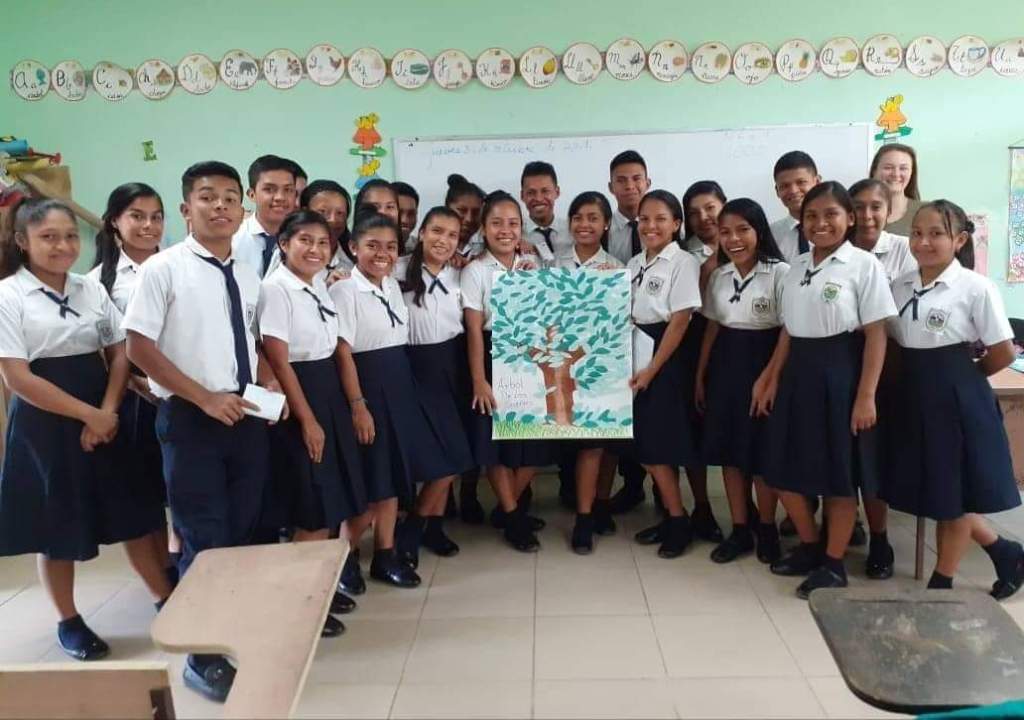
However, as I’ve said before, the directora asked me to not work with the teenagers and just work with grades preK-6th. Despite this, I’ve been edging my way into the high school English classrooms where the students and teachers so far have been appreciating my presence. However, I’m not only interested in supporting with English classes, but also youth empowerment and life skills as well! So, my first project in the high school was a life skills workshop I designed (or Frankenstein-ed, if you will) and called Guía de tu vida. The workshop consisted of two sessions: considering personal values and setting life goals based on those values.
11B working in groups 👏
I facilitated this workshop to all the eleventh and twelfth graders, totalling around 100 students. There were about 22-27 students per class, so I was a little nervous about addressing four large groups of teens who have seen me around school but didn’t really know me. Because it was my first project, I decided to use it as a practice for the LLS (Leadership & Life Skills) side of my position as well as an opportunity to get to know the students of the high school better. Each session had its ups and downs, but for the most part I think the teens enjoyed thinking about their values and goals. The students especially enjoyed my follow-up session when I asked them more questions about the statistics of the session (i.e., why do you think Friendship, Responsibility, and Happiness are such common values among your age group?) and to create some posters representing the values and dreams of all the students who participated.
11A & 11B 🤩🤩
Their árbol guía (guiding tree), featuring three “dream leaves” per student, turned out beautifully and will be displayed in the 12th grade classroom for the rest of the year.
Estes estudiantes son tan creativos 🎨
Regional Meeting
G82 & G84 TELLS 📚❤️
October ended with my cohort’s second RM (regional meeting). For my province of Coclé, that meant that all 43 of us across sectors (Education, Health, and Agricultural) united in the lovely El Valle, my friend Adam’s site as well as a popular tourist destination in the province. The new G85 SAS and WASH volunteers experienced their first RM this time, so we all did our best to welcome them into our tribe of “Locosanos.” This RM brought thought-provoking info sessions, cool valley weather, two new inspiring regional leaders, and just a grand old time with province friends old and new. We G84 TELLSers also had the opportunity to send off our predecessors, G82 TELLS, with words of encouragement as they prepare to COS (close of service) in six months.
Yes, RM was a blast. However, a sadness loomed over me those days with the knowledge that one Coclésano was not with us; a friend, who I will keep anonymous for respect to their privacy, had to leave Peace Corps Panamá abruptly earlier this month for reasons out of their control. This person was very inspiring to me as a fellow volunteer. I boasted to other PCVs about how well-integrated this person was in their community and how many impactful, collaborative projects they’d started. They were also someone well-respected by the Peace Corps community as a creative, responsible PCV who contributed a lot to the organization itself. Peace Corps Panamá will miss them, as will I.
I didn’t realize how hard missing one volunteer would hit me. But now I know why it did: Peace Corps volunteers are family. In a job and lifestyle that attracts loneliness like a magnet, the confidence and comfort of fellow volunteers is undeniably what keeps us putting our best feet forward in our communities. Like family, we disagree and cause drama. We have miscommunication, gossip, and tension. However, the love and admiration shared between PCVs is something special that I don’t think could exist in any other line of work.
When I’m struggling, dreaming, or trying to connect with a power greater than that within me, I know all other volunteers understand what I’m experiencing. We’re pasear-ing through this journey together. I try to remember these times with everyone before they’re over.
Peace Corps Coclésanos 🕊️👒
Nos vemos en noviembre… Thank you for reading everyone. Mercury Retrograde is hitting me hard! Writing down my feelings (even though this is just the tip of the iceberg) has been cathartic and fufilling for me. This blog is just as much for me as anyone out there reading it. One more time, thank you and Oujeeeeeeeee!
My host family visited and brought me dinner last night to welcome me to my new home ❤️ my heart is overflowing!
After I returned from In-Service Training, a lot of things began to fall into place. My English teacher counterpart Elizabeth started requesting me for more help with her 5th grade classes; the gabinete (counseling department) met with me to collaborate on ideas for social work, summer school, and youth empowerment programs; my English teacher counterpart Zaida and I met to discuss how I can better support the teens in English and leadership projects; my first real project, a beginner’s English conversation course for the teachers and administration at my school, took off; and I moved into my own house, which is something I’ve been anxious to do for about three months.
Now it’s practically October 🎃🍂☕
But in Panamá, autumn doesn’t happen. Rain is picking up, but no distinct changes in climate or weather have established a new season as this time of year does at home.
However, September was still full of changes for me. It felt like a new beginning, the way it feels when the leaves start to change colors and the college students return to campus in Hanover. This blog is dedicated to these turning points and surprises.
Peace Corps Cribs
La casa anaranjadaarriba la loma🧡No closet? No curtains? Este es la solución
Moving out was honestly a kind of bittersweet experience. Even though I’ve been craving my own space, somewhere where I won’t have to worry about running into a host brother-in-law on my towel-clad trek to the latrine or stressing out my host mom with my inconsistent eating habits, I knew deep in my heart how much I would miss my host family and the warmth I received from them every day.
One Saturday earlier this month, I found the only muchacho in town who owns a truck, Javier (also a bus driver for Chiguirí Arriba), and paid him to take me to Penonomé and help me transport a sofa-bed, mini-fridge, and stove back to our home in the mountains. Once I had these things in place, I met my new next-door-neighbor Eliecer who helped me rig up some borrowed electricity from his home since my home itself has none installed. My campesino landlord Señor Gumercino (who is a farmer in a community lejito de aca called Palmilla) tells me that an electrician is coming soon. He also said we’d meet to discuss the rent weeks ago… Vamos a ver.
The house is coming together, poco a poco
What also welcomed me to the house was a turantula on the wall and a bat in the latrine. After sharing this with my cohort peeps, they decided that it was time for me to move out. Luckily, Eliecer was there to save the day and banish the critters from my home. Eliecer has been helpful and supportive in many other ways so far, such as watching over some belongings I once left outside overnight to make sure no street hustlers climbed my fence to nab them. He’s just one example of how Chiguirí Arrib-ians, and Panamánians in general, are always looking out for their gente, even when it’s Gina la gringa.
Some unexpected previous tenants
Moving my small belongings, like my books and clothes, was also a group effort. A group of boys and from the high school, Ángel, Kevin, and Noel offered a hand after seeing me walk down the unpaved road towards the center of town carrying all my bags. Once we’d dropped everything off, Kevin said to me “welcome to the house!” in perfect English. Wao! It was another example of how caring and sincere the people of this community are, right down to the jóvenes.
Of course, I still had some small things left in the house on my last evening with my host family. I asked for my host sister Carmen and host sobrinos Yariela and Ariel Antonio for help. However, as we set off with arms full, we heard a shrill, shrieking cry coming from the house. Natalie, my three-year-old host niece, was upset that I was leaving and wanted to help carry things with the big kids. After much hassle, I handed Natalie one of my empty water jugs and we set off once again with one additional member of the moving team.
We walked down the hill towards town as Natalie’s little stubby legs kept enthusiastically with our pace. On the way, Carmen and I talked about how things were going in school, considering I’d recently started assisting Teacher Zaida with the 11th (Carmen’s grade) and 12th graders’ English classes. Carmen said that she would like to have more of a presence from me in her classes, mentioning that when other outside programs come to assist the high schoolers they’re more often shaming than supportive. I remembered back to my first day at the school when the principal told me not to work with the high school because the students were lazy and unmotivated.
This sentiment has been echoed time and time again by teachers and older members of the community and it’s become one of my biggest pet peeves. Because, truly, there are some amazingly talented, inspired students here in the high school. However, because the community itself is more conservative and tranquilo, the students show their intelligence in creative, introverted ways rather than raising their hands and speaking out their thoughts. I told Carmen that together we could work on ideas for projects, whether they be English-related or phys ed or arts or workshops or whatever, and do more to support and celebrate the jóvenes how they deserve.
After everything was set inside the house, I hugged Carmen and my host sobrinos goodbye, telling them to please join me for baking cookies and watching soccer games in Villa Tavidal Arriba whenever they’d like. The next day or so, I cleaned, organized, and decorated my little house on the hill. It’s still a work in progress, but I’m loving every minute of fixing up my home.
Cuando la hamaca está en lugar, la casa es un hogar Looking forward to more soccer games in Villa Tavida Arriba ⚽
Profe English Class at Pablo Alzamora Vargas
In the midst of moving, the first solo project I’ve started in my community is an afternoon English class for the teachers and administration at my school. We meet once a week and cover basic conversation topics through dinámicas and group work. So far, we’ve covered greetings/farewells, numbers, the verb “to be,” professions, and emotions. From what I’ve observed, the teachers are enjoying the class which not only allows them to practice English but also take a break from teaching themselves. I equally have been enjoying my time with this group and getting to know the Pablo Alzamora Vargas faculty a little better.
Lesson 2: “to be” & emotions✨ Good job teachers! 👏
Readers Theater in Aguadulce
Over twenty primary schools around Coclé competed in the third annual Readers Theater competition taking place at PCV Bridget’s school in Aguadulce
The first Friday back after IST was the provincial Readers Theater competition in Aguadulce. My Bremen Town Musicians from Escuela Membrillo competed against nineteen other schools. It was fun to watch all these schools perform their scripts on stage and show off their English skills. It was equally entertaining to witness all of the TELLS PCVs silently recite their schools’ script along with the students during their moment on stage, seeming like proud teachers or parents. I hope to return to Escuela Membrillo and work with students and teachers there on other projects.
I was so proud of these kids and their excellent English skills! 🐎🐈🐕🐓
Tu Vida in Nata
PCV Zulema, a volunteer who’s been in Panamá for over a year now, asked for help with her youth empowerment workshop Tu Vida in her community Nata. Nata is a big town, similar to Chanel’s community of Anton, and Zulema works in the primary school there. She decided to offer Tu Vida, a workshop covering themes such as bullying, consent, and self-esteem, to her outgoing sixth grade students before they transitioned into the secondary school. Along with PCV Matt, I helped Zulema facilitate the workshop’s themes and objectives through different activities. I particularly liked guiding the “self-esteem tree” in which every student writes down things that like about themselves to create a representation of everyone’s skills, values, and interests.
El árbol de autoestima 🌳 🍃
Celebration of the foundation of Chiguirí Arriba
Last week marked the founding of my community Chiguirí Arriba. The school celebrated with the typical activities: a reinado (or coronation), traditional dance performances, and lots of food.
El reinadode kinder 👑
The day of the celebration I had a meeting with the junta comunal, the local government representatives for the corregimiento. So, I didn’t have much time to attend the festivities but managed to peep in on some of the dance performances of the folclore club.
The cutest campesinos in Coclé 🧡❤️💙💚
And now…
La vida de chiva con Joanna 💁🏼♀️💁🏿♀️
I have a lot more to look forward to! Youth workshops, university programs, Ultimate Frisbee training, and more all are written down in my agenda. I’m busier than ever and happy to be so.
On the first night spent in my new home, I was brushing my teeth, looking around at my disorganized belongings and rigged up electric outlets when suddenly I started crying. The full weight of my Peace Corps experience hit me in that moment. I realized that never before in my life had I felt this independent. I’ve never held this much creative power over my personal and professional life. I’ve never been exposed to so many enchanting perspectives, both in my Peace Corps and Panamánian communities. And I’ve never felt love for an experience like I have for Peace Corps Panamá and the town of Chiguirí Arriba.
October’s motto: all smiles, no slumps 🤗💜Nunca cansada de estas vistas 💚Todos dicen “Chiguiríííí” 😁❤️
It’s been about a week since my cohort and I left Volcán, the town that hosted us for our second week of In-Service Training. Chilly and lively, Volcán is home to PCV Lesley who graciously welcomed us into her beautiful site in the province of Chiriquí. She arranged for us to stay with some of the teachers at her school, and we paired up into families with each other for the week. My friend Morgan was my roommate for the week, and we stayed with the sweet and accommodating Directora Ana and her nephew Jorge. Ana has no children of her own but raised Jorge for all his seventeen years. Jorge was also very sweet as well as excited to have some gringas staying in his home. Morgan and I especially appreciated Jorge’s determination to find English subtitles for his dubbed copy of Black Panther as well as his random desire to have a vaquero-themed photoshoot on our last night in Volcán.
Directora Ana on the other hand was a little anxious to have gringas in her house only for fear that we would be uncomfortable or not like her food. I did my best to dismiss these fears for her by letting her know how luxurious her home was and how well she cooked. Throughout the week, Ana made sure Morgan and I were prepared for all of our activities and travels. On the morning we left to return back to our sites, I casually mentioned that my eye had been bothering me due to an allergic reaction. Alarmed, Ana told me that I must use some natural medicine. She ran outside and returned with two sage leaves. “Put them inside your bra,” she directed me, both through vocal directions and gestures, “You will inhale the sage and it will help heal your eye.” Not seeing any reason to dismiss this suggestion, I did as she told. I couldn’t help but laugh once I was changing back at home and saw two shriveled leaves fall from my shirt. My eye did feel better though! Who knows…
Though the two of us worked hard every day and returned home exhausted every night of training, Morgan and I came to appreciate the warmth and entertainment our host family extended to us during our stay.
La familia MurgasChomba, one of the family’s three horses greeting us and looking for breakfast 🐴
During training, I had the opportunity to reunite and work
with some of my favorite people: the volunteers of my cohort, G84 TELLS. I was
surprised at how happy I felt to be back in training-mode, surrounded and
inspired by my friends. We shared stories, both positive and negative, from our
past four months in-site, as well as enjoyed the break away from our community
responsibilities.
At La Iguana, Coclé before leaving for Volcán, Chiriquí
Saturday at the beach between the two weeks of IST
I also was refreshed and reenergized by the support from our
sector team, Krystie, Hu, and Johanna. It was great to finally meet Johanna,
our sector manager, in person. She, along with Krystie and Hu, had been helping
me navigate conversations and steps forward with my landlord’s family for the
previous month. Thanks to her help, I should be moving into my own place by the
end of September!
Under the sector team’s guidance as well as help from some
well-seasoned TELLS volunteers from older cohorts, my fellow G84ers (also
referred to as the Honey Monsters…listen, it’s a convoluted, cornflake thing)
and I received and facilitated a variety of Teaching English, Leadership, and
Life Skills workshops including the following:
Mentoring sessions
Johanna invited a group of university students from David to
participate in a mentoring session facilitated by us PCVs. However, very few
students actually showed up, so we ended up mostly just pairing off into PCV
partners for the activity. Despite the low attendance, I found this session
very useful in establishing relationships, sharing interests, and sharing
professional goals and dreams in a formal mentoring setting. With the support
of the secondary English teachers and school counseling department, I plan to
adapt this session into a workshop for the senior high school students at Pablo
Alzamora Vargas.
Tu Vida day camp
Tu Vida is a Peace Corps-designed day camp for 4th-6th graders. The two-day camp offers sessions on healthy decisions, bullying, breaking stereotypes, and values. I’m excited to have the opportunity to assist PCV Zulema with her own Tu Vida in a couple of weeks.
Over the two Tu Vida mornings, I facilitated these themes alongside Kaylee and Hanna. Again, for this activity, we had very low attendance. We expected 10-15 participants per group but ended up with around 5 kids each. This was understandable considering all public schools in Panama were on vacation between trimesters and most students spent this time with their families. However, Hanna, Kaylee, and I cherished our participants who we came to realize were creative, thoughtful, and brave individuals. We were proud of ourselves for teaching such complex themes, especially racial/gender stereotypes, to these young participants. And we loved watching them get crafty for the last activity: designing a group flag for the Tu Vida closing ceremony.
MECROC = Melani, Edgar, Cesol, Rachel, Oliver, and Cristian; our Tu Vida champs
Elige Tu Vida introduction
Under the guidance of PCV David, PCRV (Peace Corps Response Volunteer) Eliana, and Eliana’s counterpart Particia, our cohort split off into small groups to practice sessions from the Peace Corps workshop Elige Tu Vida. Like Tu Vida, ETV focuses on goals, decisions, and values. However, it is designed for teenagers and also includes a 2-hour session covering sexual and reproductive health. I partnered with Patricia to reenact a short skit about two teens asking their older siblings questions about sex. I played the part of the hermanita while Patrica played my hermana mayor. Other volunteers filled in the roles and facilitated a condom demonstration during the skit. As a result, the skit demonstrates the kinds of questions, preoccupations, and misconceptions young teens have about sex and what they need to know to be safe and comfortable in making decisions regarding sex. In addition to the skit, other groups facilitated sessions on STDs and sex myths as these topics have been covered in ETV. This activity helped me feel more prepared to assist with ETVs and sexual health charlas.
Thanks Hermana Patricia for helping me feel prepared to make (or not make) healthy sexual choices!
LDGE/Teacher training at UNACHI
One of my favorite parts of training was the time we spent at the UNACHI university in David, the provincial capital of Chiriquí. Before training, we all had a choice to facilitate a teaching methodology workshop or a leadership workshop during our time at UNACHI. Along with five of my compañeros, I participated in the leadership workshop LDGE (Leadership Development for Global Education). Over the course of two days, our LDGE facilitators and participants covered topics such as leadership styles, values, goals, what challenges us to do the right thing, and societal expectations for the next educated generation. I felt totally in my element while sharing stories about my own challenges and successes and encouraging the participants to do the same. The UNACHI students that participated in the teaching methodologies and LDGE workshops thanked us PCVs during a closing ceremony, involving song and dance performances. It was a great way to close off training and re-energize our minds for projects back at site.
Let’s go LDGE!
Demonstrating coersive leadership!
Towards the end of training, we also had the opportunity to present a little bit about our communities to our fellow volunteers and bosses. These presentations reflected the diversity of Panamá; Danielle talked about her experiences working in a small indigenous reservation community without cell signal or electricity. Kasey shared some stories about working in a university setting in Santiago, one of the most up-and-coming cities in Panama with a population of over 40,000. And I spoke about Chiguirí Arriba, explaining that while it appears to be a quiet mountain community it is also building an industry in eco and agro-tourism.
I realized while listening to these stories and reflecting on my own that Panamá is really our home now. Before this week, I felt unsure about whether not I really belonged in Panama. Now I am confident that, while it’s still under construction, I have a place here. I have a home. I have projects and people who want to see me succeed. I never felt that I would see anywhere else but Hanover, Indiana as my home. But after leaving Volcán and returning to Chiguirí Arriba, my heart rested knowing I was back in my own mountains.
And, while it’s great to be back home, training made me realize how much more of Panamá, as well as the Peace Corps experience, I have yet to explore. I thank Peace Corps for giving me this journey, pushing me to carve my own path and build a life of my own in my community. And I thank IST in Volcán for providing the fresh air and company I needed to realize these things.